
Laser surgery for prostate obstruction
- Hospital stay1 or 2 nights
- Catheter1 or 2 days
- No visible scarsdone through the urethra
- Back to normalin 3 to 4 weeks
What is it used for?
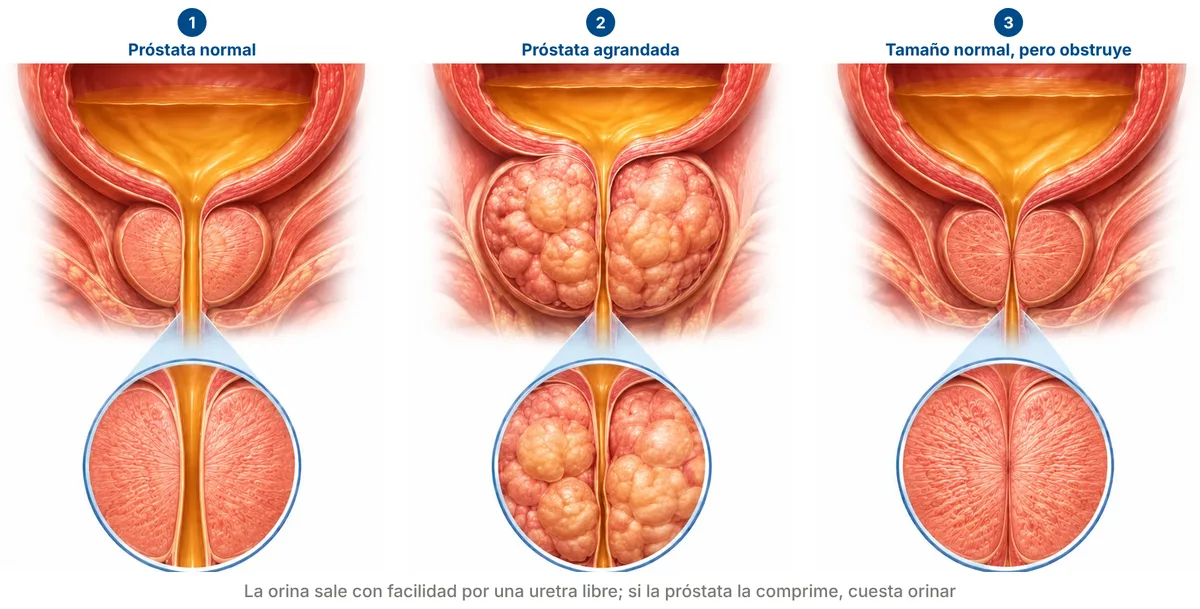
The prostate tends to grow with age. This growth is NOT cancer; it is normal and is called benign prostatic hyperplasia. But it can squeeze the urethra, the tube urine flows through, and that is when symptoms start. Sometimes the prostate is a normal size but still blocks the flow. The most common symptoms are:
- Difficulty starting, or a weak or interrupted stream.
- Getting up several times at night to pass urine.
- A sudden urge to pass urine.
- A feeling that the bladder has not emptied completely.
HoLEP removes the obstructing part of the prostate so that urine flows easily again.
What does it involve?
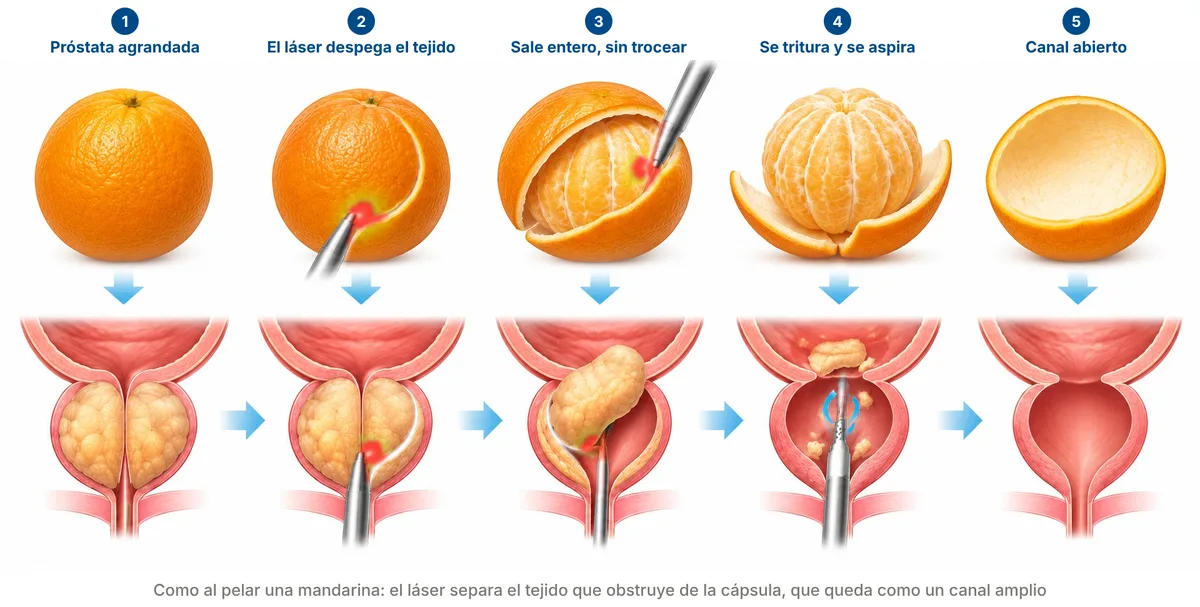
HoLEP stands for Holmium Laser Enucleation of the Prostate. It is done through the urethra, with a thin instrument carrying a camera and a laser fibre, with no cuts in the skin. The laser separates the obstructing part of the prostate, which is then removed. The tissue is sent to the laboratory to be analysed and rule out other diseases.
Who is it for?
For men with symptoms of prostate obstruction that do not improve with medication, who cannot tolerate medication or simply prefer a quick, lasting solution. It is suitable for prostates of any size, including very large ones.
Advantages
- Less bleeding than traditional surgery (TURP or open surgery).
- A shorter hospital stay and faster recovery.
- Long-lasting results: you are unlikely to need another operation in the future.
- Suitable for both small and very large prostates.
Hospital stay and recovery
- You will stay in hospital for one or two nights.
- You will have a bladder catheter for one or two days.
- It is normal to see some blood in your urine for a few days. Drinking plenty of fluids helps.
- You may have small leaks in the first few weeks. They usually go away on their own.
- Avoid physical strain and sex for at least a month.
- Most patients are back to normal in 3 to 4 weeks.
Risks
It is a safe, effective procedure that greatly improves quality of life. Even so, like any operation, it has risks. They are uncommon; the most frequent are:
- Bleeding and urinary infection. Bleeding improves with drinking fluids. To prevent infection we give you an antibiotic before the operation.
- Urethral stricture. It can occur, as with any operation through the urethra. If it does, you may need another procedure to treat it.
- Permanent urine leakage. The risk is low.
This operation has a side effect that affects a high percentage of patients:
- Loss of ejaculation. It happens to most patients (about 8 or 9 out of 10): no semen comes out at orgasm. Orgasm itself barely changes and the risk of erection problems is low.
When to call us
Call us on +34 944 393 510 or go to the hospital emergency department if you have:
- A temperature above 38 °C.
- Heavy blood or clots in the urine that do not improve with drinking fluids.
- You cannot pass urine or the catheter stops draining.
Pelvic floor exercises: starting them before surgery and continuing afterwards helps you regain urinary control sooner.
Kegel exercises for men (PDF)How to do them
Any questions?
Book on +34 944 393 510, by WhatsApp on +34 688 873 045 or email us at gestion@urologiaclinica.biz.
This page summarises general information about the technique. It does not replace your urologist’s explanation or the informed consent form, which you will receive before the operation.
