
HYDROS: Aquablation of the prostate
Waterjet surgery for an enlarged prostate
- Hospital stay1 or 2 nights
- Catheter1 or 2 days
- No heatrobot-guided waterjet
- Ejaculationpreserved in almost 9 out of 10 men
What is it used for?
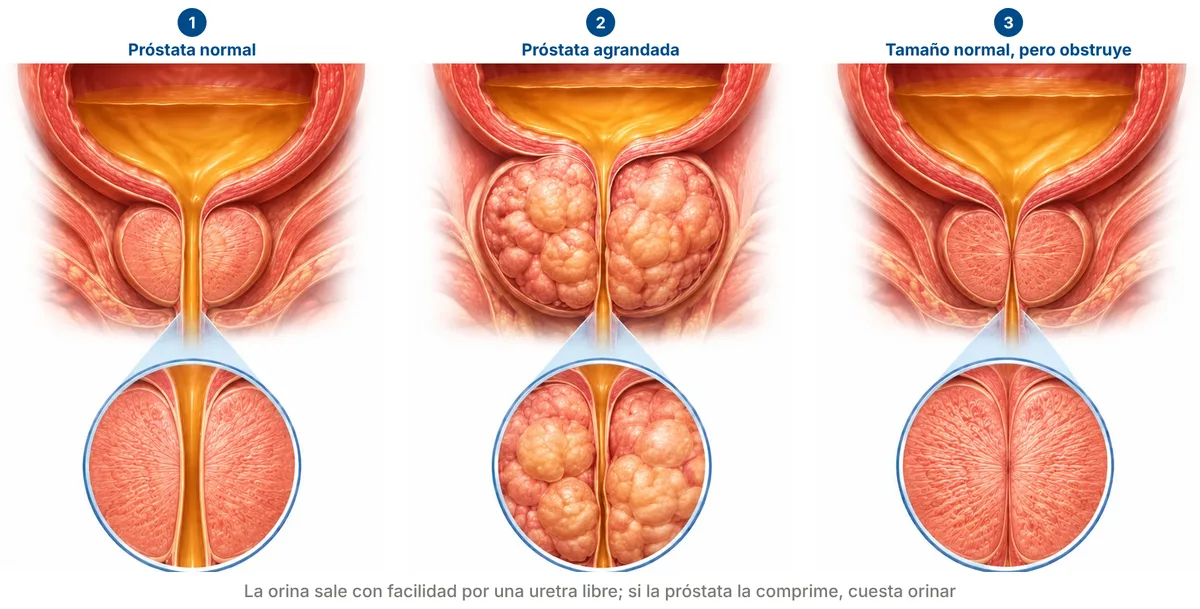
The prostate tends to grow with age. This growth is NOT cancer; it is normal and is called benign prostatic hyperplasia. But it can squeeze the urethra, the tube urine flows through, and that is when symptoms start. Sometimes the prostate is a normal size but still blocks the flow. The most common symptoms are:
- Difficulty starting, or a weak or interrupted stream.
- Getting up several times at night to pass urine.
- A sudden urge to pass urine.
- A feeling that the bladder has not emptied completely.
Aquablation removes the part of the prostate that blocks the urethra, so that urine flows easily again.
Our experience. In 2021 we were the first centre in the Basque Country to treat the prostate with Aquablation, and later the first centre in continental Europe with the HYDROS system.
What does it involve?
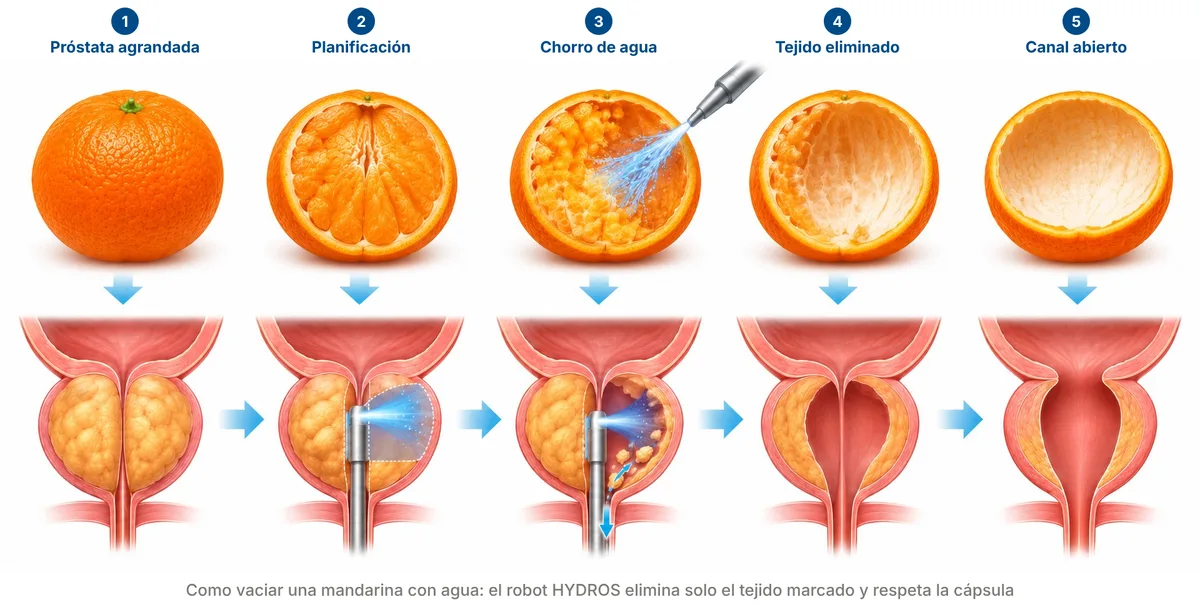
It is a technique with no cuts in the skin: it is done through the urethra. It removes the obstructing tissue with a high-pressure waterjet, directed by a robot with the help of artificial intelligence. It uses no heat. It is done in two steps:
- Planning. The surgeon sees the whole prostate with ultrasound and an internal camera and marks exactly which area to remove. The areas that control continence and ejaculation are left untouched.
- Treatment. The HYDROS robot directs the waterjet and removes only the marked tissue, with great precision.
Who is it for?
- Men with moderate or severe urinary symptoms caused by obstruction.
- When medication has not worked well enough or is poorly tolerated.
- Men who want an effective treatment with the lowest possible risk to ejaculation.
- It works well in medium-sized prostates. For extremely large prostates, your urologist will assess whether it is the best option.
Advantages
- Long-lasting relief of urinary symptoms.
- Low risk of urine leakage and sexual problems.
- Most patients (about 9 out of 10) keep their ejaculation.
- Great precision thanks to robotic assistance.
- Quick recovery.
Hospital stay and recovery
- You will stay in hospital for one or two nights.
- You will have a bladder catheter for one or two days. Most patients go home without a catheter.
- For a few days you may notice stinging or a sudden urge to pass urine. This is temporary.
- You may see some blood in your urine for the first few days. Drinking plenty of fluids helps.
- Your urologist will tell you when you can resume strenuous activity and sex.
Risks
Like any operation, it has risks. They are uncommon; the most frequent are:
- Bleeding and urinary infection. Bleeding is low, slightly higher than with HoLEP.
- Permanent urine leakage. The risk is very low, because the area next to the urinary sphincter is preserved.
- Changes in ejaculation. They are uncommon: about 9 out of 10 patients keep it.
Insurance cover
It is a new technique and is not yet covered by insurers. We will give you full details for your case before the operation.
When to call us
Call us on +34 944 393 510 or go to the hospital emergency department if you have:
- A temperature above 38 °C.
- Heavy blood or clots in the urine that do not improve with drinking fluids.
- You cannot pass urine or the catheter stops draining.
Pelvic floor exercises: starting them before surgery and continuing afterwards helps you regain urinary control sooner.
Kegel exercises for men (PDF)How to do them
Any questions?
Book on +34 944 393 510, by WhatsApp on +34 688 873 045 or email us at gestion@urologiaclinica.biz.
Information about HYDROS: 688 681 019
This page summarises general information about the technique. It does not replace your urologist’s explanation or the informed consent form, which you will receive before the operation.
HoLEP or Aquablation? Compare the two techniques (PDF)
The technology of the HYDROS robot

FirstAssist AI®
Designed to improve efficiency and deliver more precise treatment planning using artificial intelligence.
Developed from:
- Real Aquablation procedures.
- The experience and input of expert surgeons.
- Image recognition software.
It helps surgeons to:
- Identify critical anatomy.
- Suggest an optimal, personalised treatment plan for each patient.
- Streamline the workflow during the procedure.
Advanced image guidance
Next-generation ultrasound
- Improved image capture.
- Specifically tailored for Aquablation.
Integrated digital cystoscope
- High-resolution video with a wide field of view.
- Consistent image quality thanks to its single-use design.
Two high-definition touchscreens
- Better visualisation of the anatomy.
- Ultrasound and cystoscopy can be viewed at the same time.
- Smoother interaction between user and platform.


Robotic resection
Heat-free waterjet
- Resects tissue with a high-velocity saline jet.
- Removes obstructing tissue while preserving critical anatomy according to the treatment plan.
Robotic assistance
- Carries out the treatment plan approved by the surgeon.
- Standardises surgery across prostates of different sizes and shapes.
Waterjet
- Up to 2.4 cm deep.
- Sweep of 225°.
Optimised workflow
Integrated tower
- Efficient set-up and preparation in a single footprint.
- A better experience for both surgeon and theatre staff.
Adjustable touchscreen
- Better surgeon ergonomics thanks to its central position.
Intuitive software interface
- Simplifies the procedure workflow.
- Provides step-by-step guidance during the operation.
All of this improves efficiency, enhances the surgical team’s experience and delivers precise, consistent treatment plans.
